




AI Data Fabric
The foundation for intelligent decisions
Your AI agents can’t “do the work” if they don’t have a clean, current view of your actual risk environment. Cogent's AI Data Fabric connects to the security tools you already run and turns fragmented signals into a living model your agents can safely reason on, then act on under your control.
Real-time data ingestion
Streaming architecture processes changes as they happen, not in batch jobs. Risk assessments reflect your current environment state.
Cross-tool entity resolution
Language models detect when different tools report the same asset under different names and merge them into one authoritative record.
Automated relationship mapping
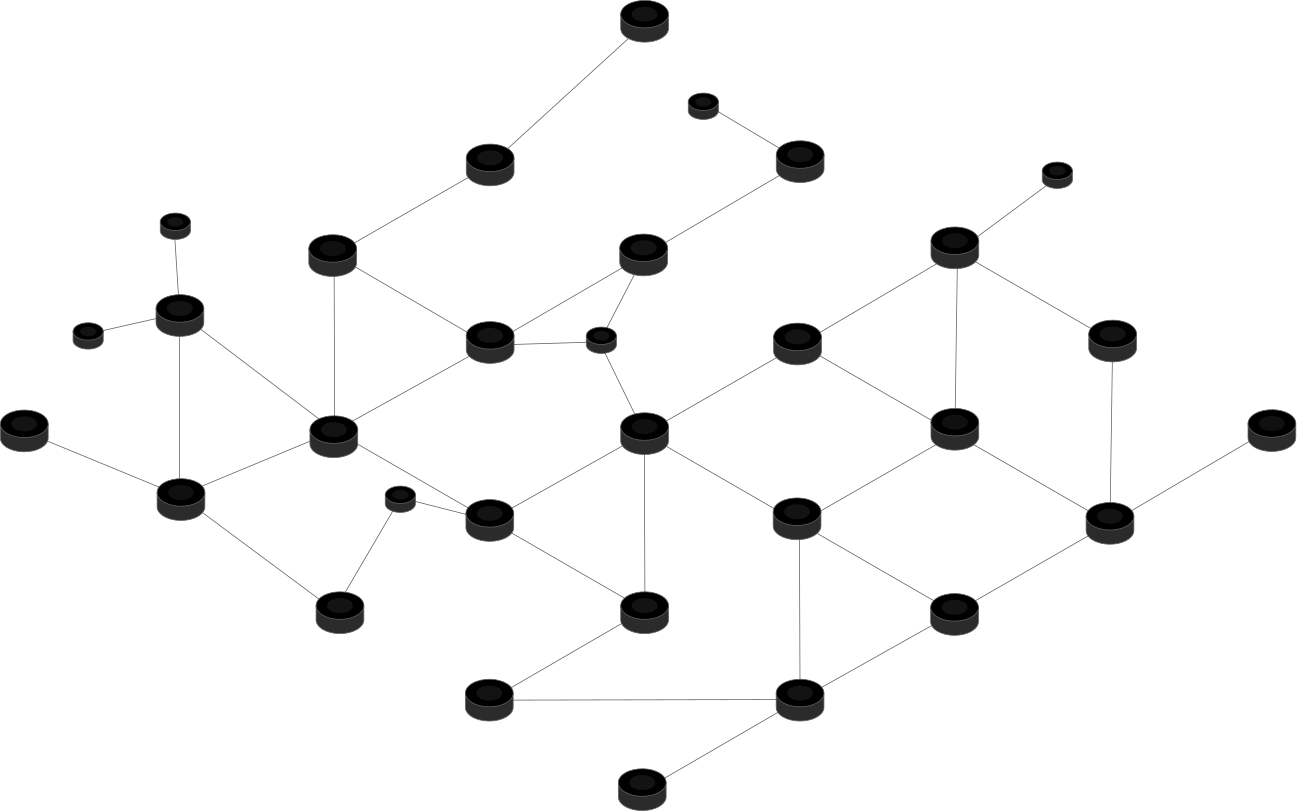
A unified knowledge graph links each asset to its owners, business functions, network exposure, and compensating controls.
AI Reasoning Engine
Analyst-grade decisions at machine speed
Cogent's AI Reasoning Engine operates like a security analyst who never clocks out. It ingests raw findings, pulls in missing context, and delivers prioritized, explainable conclusions in seconds through a network of specialized agents that chain tasks in milliseconds.
Specialized agents
Different agents handle normalization, enrichment, risk assessment, and remediation planning, each optimized for its step.
Domain-trained intelligence
Models learn from millions of real decisions, recognizing contextual factors that generic CVSS scores miss: exposure, controls, exploit trajectory.
Visible reasoning
Every output includes the full chain of logic: data sources queried, agents involved, and why this path was selected over alternatives.
Adaptive Execution
Full governance over every automated action
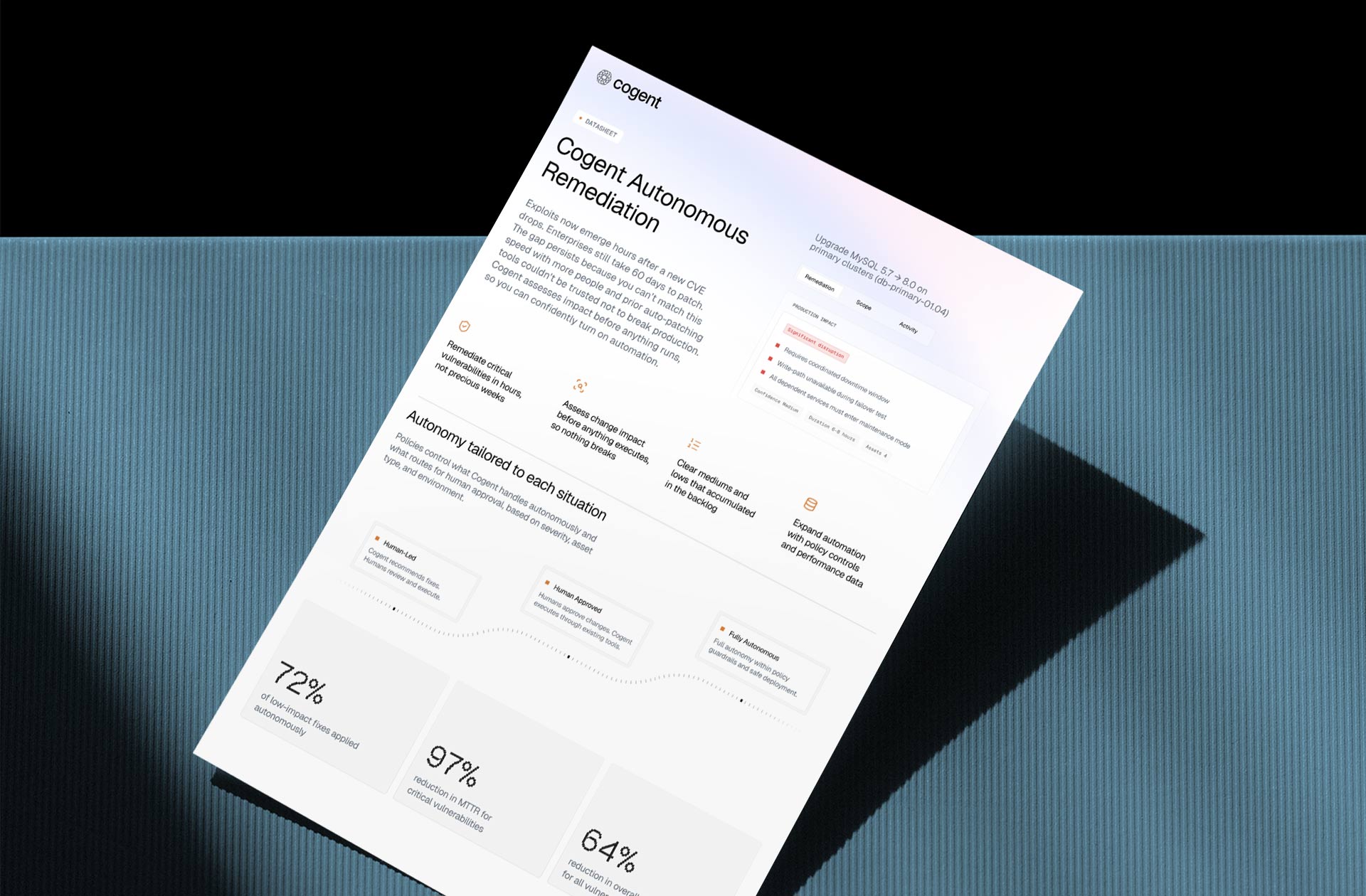
Purpose-built workspaces put your team at the center of every automated decision. Review what agents recommend, approve or reject actions before they execute, and steer priorities in real time. Complete reasoning trails give you full transparency into what the AI did and why.
Granular approval workflows
Decide where agents act independently and where they pause for sign-off. Configure by action type, severity, or asset sensitivity.
Policy enforcement
Agents check your defined guardrails before every action. All agent activity respects your defined maintenance windows and operational constraints.
Continuous human steering
Your team can redirect agents, adjust boundaries, and override decisions at any point. Future behavior adapts based on corrections.



Most AI chats. Cogent works.
Cogent doesn't just summarize your vulnerabilities, it does the work to fix them. Our AI agents execute the complex, multi-step investigations and cross-team coordination that used to steal a human’s entire afternoon, finishing the work in seconds.
Cogent’s agentic AI platform
Intelligence that reacts
in real time
Risk changes constantly. Cogent's agents respond immediately when something meaningful happens in your environment.
Asset suddenly exposed to the internet
Risk score immediately elevated, alert created
Compensating control removed
Previously low-priority vulnerability becomes critical
Patch applied
Remediation is verified and vulnerability is removed
Built for trust and control
Cogent is designed for enterprises that need governance, not just speed. Every decision is explainable. Every action is controlled.
Can we tune Cogent to our policies, SLAs, and workflows?
Yes. During onboarding, we capture your organizational preferences, so our systems can respect them.
What if Cogent gets something wrong, how do we correct it?
If something looks off, you can regenerate the recommendation with additional context or correction. The system learns from your feedback and continues improving over time.
How do you prevent the AI from hallucinating?
Cogent isn’t built on a generic “ChatGPT wrapper.” The models are adapted for this domain, with constraints and guardrail checks at each step of reasoning. When it needs extra certainty, it reruns verification and can label the response as guardrail‑verified.
What happens if the AI doesn’t have enough information?
It won’t guess. When the agent doesn’t have enough signal, it will surface unknowns/low confidence and pull more sources or ask for context. Once confirmed, it stores that answer so you don’t re‑investigate next time.
Can we keep a human in the loop until we trust it?
Yes. Most teams start in passive mode while security audits the outputs and builds trust. When you’re ready, you can selectively enable autopilot by workflow or environment.
Go deeper on Agentic AI


Applying AI to cybersecurity