Blog
Product
Introducing Cogent Security Assessments: Bring Human-Validated Risk Into Your Vulnerability Program
Pentests, bug bounty findings, and threat models shouldn’t live in spreadsheets and separate workflows. Cogent connects them with scanner data to improve prioritization, streamline remediation, and automate closure.
6 min read


Some of the most important security findings in an organization never come from a scanner.
A penetration tester may prove that a vulnerability can actually be exploited. A bug bounty researcher may uncover a weakness that automated tools missed. A threat model may identify a path to compromise before a scanner ever sees it.
Yet these findings are often managed separately from the rest of the vulnerability program.
A pentest arrives as an Excel file. Bug bounty results live in another platform. Threat model findings sit in documents or tickets. Security teams have to map them back to assets, check whether scanners are already reporting the same issues, create remediation work, and keep status updated as fixes roll out.
Cogent Security Assessments brings that work together.
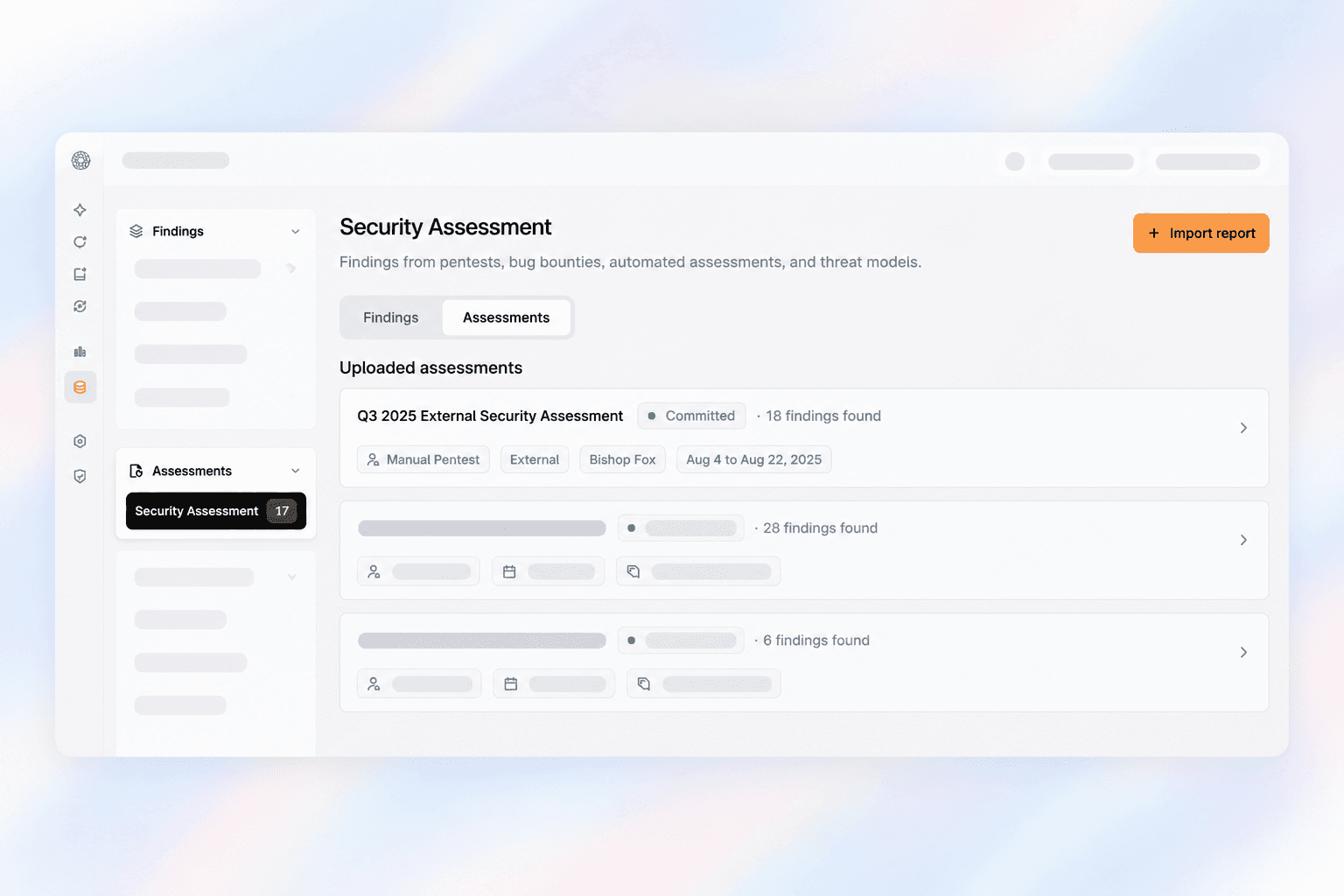
Teams can bring penetration tests, automated assessments, bug bounty results, and threat models into the same vulnerability management workflow as scanner findings. Assessment evidence becomes part of the same view of risk, prioritization, remediation, and closure.
One view of risk, regardless of where it was found
The same security issue can show up in several places.
A scanner may detect a vulnerability on an application. A pentester may successfully exploit it. A bug bounty researcher may identify another way to reach the same weakness.
Those findings are much more useful when the connections between them are clear.
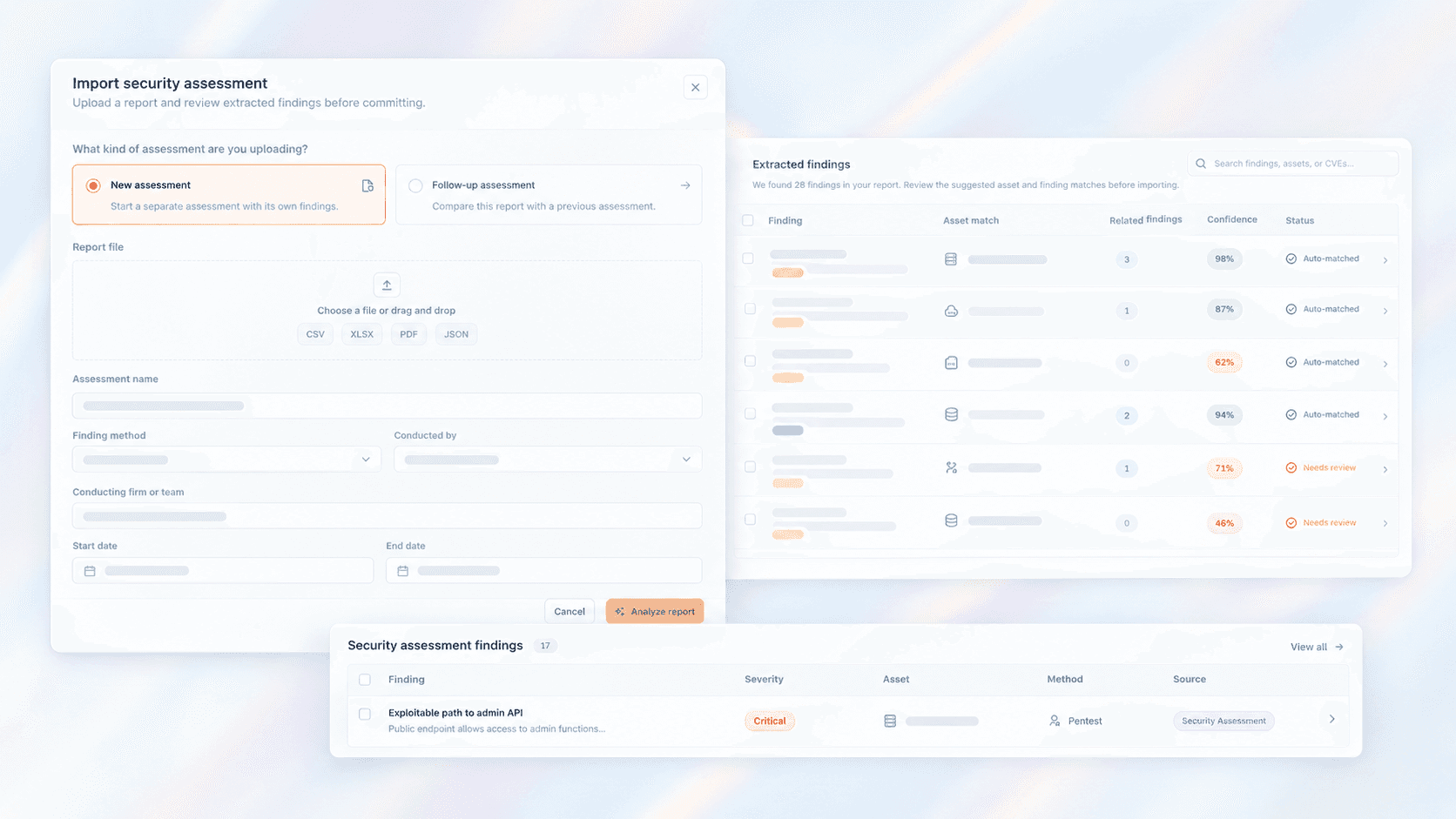
When an assessment is imported, Cogent identifies the affected assets and looks for related findings already reported by connected security tools. Scanner detections and assessment evidence can then be reviewed together, with the relationship between them preserved.
Findings that scanners never detected become part of the same view as well.
Instead of maintaining one process for scanner vulnerabilities, another for pentests, and another for bug bounty findings, security teams can work from a consolidated view of risk across the environment.
Bring direct validation into prioritization
Cogent already uses threat intelligence, exploitability, asset exposure, business criticality, and other environmental context to prioritize scanner findings.
Security assessments add another useful signal: evidence from testing performed against the environment itself.
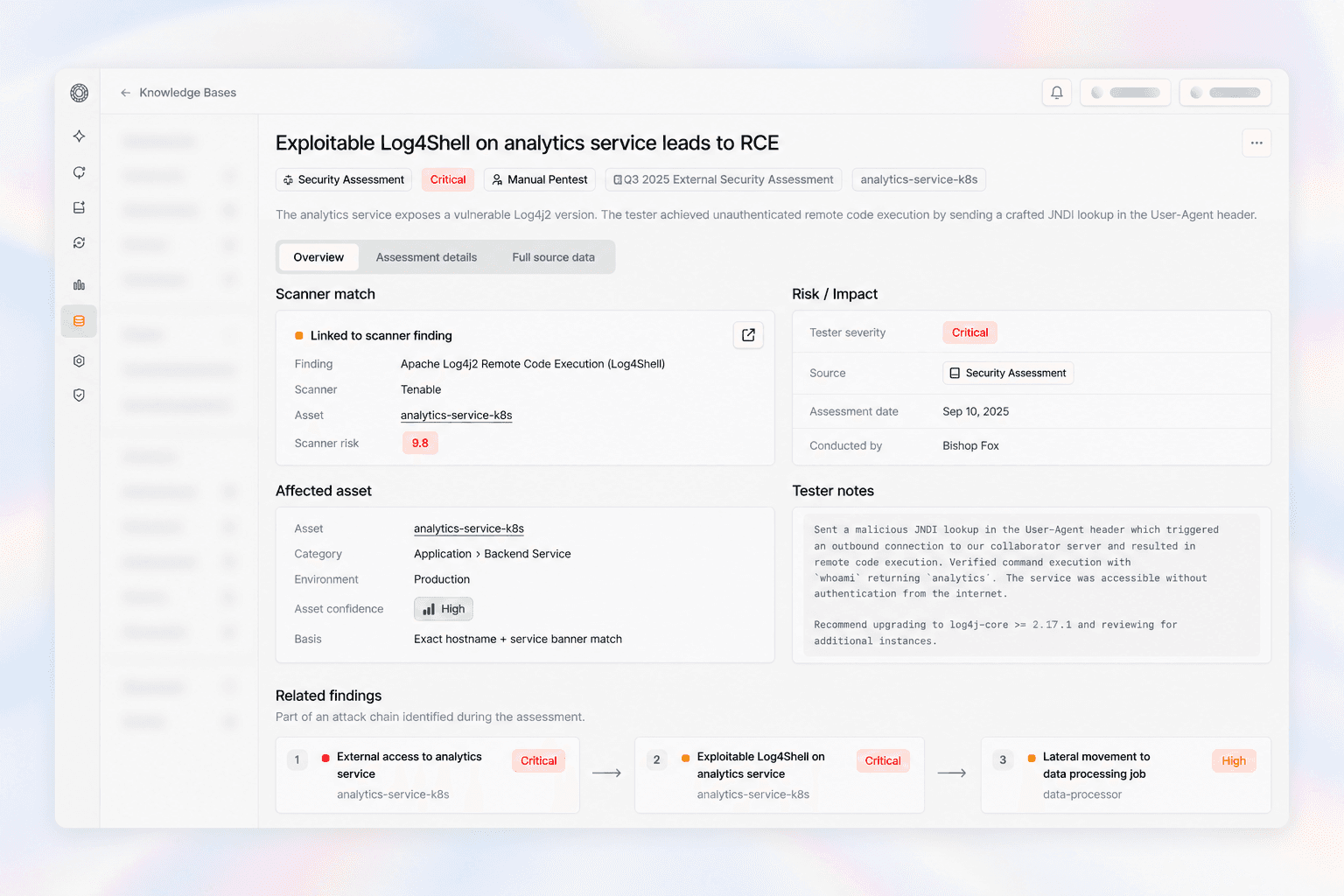
If a pentester, automated assessment, or bug bounty researcher demonstrates that a scanner-detected vulnerability is exploitable, Cogent connects that result to the scanner finding and incorporates it into risk scoring.
An available exploit is useful context. A successful exploitation against your own application is stronger evidence.
That evidence can raise the priority of the underlying scanner finding and help teams focus on issues that have been demonstrated to pose real risk in their environment.
Automate the reconciliation work
Pentest reports rarely line up neatly with the data already coming from security tools.
A report might refer to payments-api, while the asset is known elsewhere by a hostname or URL. A tester may describe a weakness in plain English while the scanner reports a CVE, CWE, or vendor-specific title. The same underlying issue can look quite different across two sources.
Cogent handles this automatically. It extracts the findings from the report, maps them to known assets, and looks for related findings from connected security tools.
Teams see the proposed results in a staging view before import. Asset matches and related findings are already populated, while anything ambiguous is surfaced for attention. Teams can quickly adjust a match, add missing context, or exclude a finding where needed.
Most of the reconciliation is handled up front, while the security team retains control over the final result.
Move findings directly into remediation
Once an assessment is complete, its findings still need to get fixed.
That handoff often means converting a report into tickets, finding the right owners, copying over technical context, and tracking the work separately from the scanner-driven vulnerability backlog.
Cogent brings assessment findings into the same remediation workflow as the rest of the vulnerability program.
The same ownership logic, SLAs, ticketing workflows, risk exceptions, and progress tracking can apply regardless of where the finding originated.
When an assessment finding matches a scanner finding, both can be handled as part of the same remediation work. Engineers get the scanner detection, assessment evidence, affected assets, and remediation context together instead of receiving separate tasks for the same problem.
Security teams can track the work in one place instead of maintaining another remediation backlog for pentest and assessment findings.
Let scanner data validate closure
Assessment reports can become stale almost immediately after they are delivered.
A pentest identifies a vulnerability. Engineering fixes it. A subsequent scanner run confirms that the vulnerability is gone.
The scanner reflects the new state automatically. The original pentest report does not.
Cogent connects those lifecycles.
When an assessment finding is correlated with a scanner finding, the scanner can continue validating the issue after the assessment ends. Once the scanner stops reporting the vulnerability, Cogent can automatically close the associated assessment finding.
For issues without a scanner counterpart, teams can still record closure based on their own validation process.
The assessment stays aligned with the current state of the environment without someone having to continually reconcile old reports against scanner results.
Connect retesting to the original assessment
Many pentests include a follow-up engagement after remediation.
Traditionally, that produces another report and another comparison exercise. Teams need to determine which findings were fixed, which remain open, and whether anything new appeared.
Follow-up assessments in Cogent can be associated with the original engagement.
The original findings, remediation activity, and subsequent validation stay connected, giving teams a continuous history from initial discovery through remediation and retesting.
One vulnerability management program
Scanners provide continuous coverage at scale. Pentesters demonstrate how vulnerabilities can be exploited in practice. Bug bounty researchers uncover issues automated tools may miss. Threat modeling surfaces risks earlier in the development lifecycle.
Each adds useful information about the same environment.
Cogent brings those signals together so teams can see scanner and assessment findings in one place, use assessment evidence to improve prioritization, and carry the work through remediation and closure without maintaining parallel processes.
Security teams spend less time reconciling reports and more time acting on the risks that matter.