AI trust and safety
Cogent's AI doesn't just give you answers. It shows you the work, proves outcomes with evidence, and puts humans in control of what matters.

Architected for transparency, built for control
AI in security can't be a black box when you're making decisions that affect availability, compliance, and risk posture. Cogent is built to give humans control over AI, with explainability and auditability built into the core of the platform.

Control every action
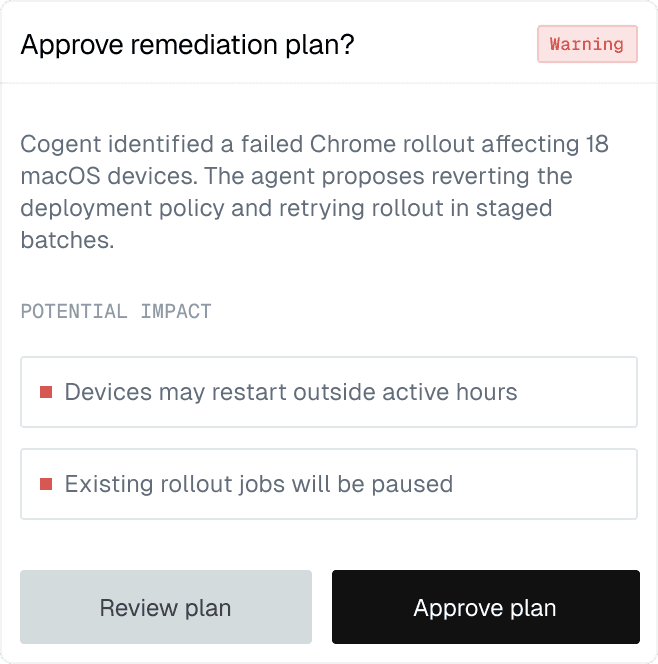
Cogent gives you granular control over AI behavior: what it can act on, when it needs approval, and how autonomy changes by environment.
Approval workflows
High-impact actions pause for human approval. Define which ticket, notification, and remediation steps require sign-off.
Policy-driven constraints
Control team assignments, ticket requirements, SLA enforcement, and escalation triggers through configurable policy rules.
Environment-aware autonomy
Match automation levels to environment context. Full autonomy in dev/test, human approval required for production changes.
Understand every decision
Every AI action comes with a clear explanation of what happened, what data informed it, and why the system chose that path over alternatives.
Factor-by-factor breakdowns
Every AI action shows the individual factors that drove it: data inputs, decision logic, confidence level, and why that path was chosen.
Confidence scoring
Confidence scores reflect data quality and source alignment. High-confidence findings move fast; conflicting data triggers review.
Source authority weighting
When sources conflict, Cogent weighs each by authority and shows how every source influenced the final assessment.
Audit every outcome
Actions generate their own paper trail. Approvals, timestamps, evidence, and verification results are captured as work moves through the system.
Continuous audit log
Every action, approval, and status change is timestamped and logged with the actor, source data, and result.
Outcome verification
Outcomes are verified, not assumed. Follow-up scans and config checks confirm the vulnerability was removed and stayed removed.
Audit-ready evidence
Supporting evidence is collected and linked as work completes. Compliance reports reference the underlying data directly.




Preventing AI hallucinations
AI that makes things up is unacceptable in security. Cogent is built with multiple validation layers to prevent incorrect recommendations.
Trusted by the world’s leading security teams








More on trust and governance



Frequently Asked Questions
Select from the list of common questions.
Do you have guardrails to prevent hallucinations or misinformation?
Yes. Cogent uses retrieval-augmented generation grounded in your actual data, multiple validation layers, and continuous accuracy scoring with human feedback loops. When the system can't explain and verify a recommendation, it won't provide one.
What if I don't trust AI to take actions yet and I want a human in the loop?
Cogent is built for that reality: the console acts as an auditing interface first, and you move toward autopilot when confidence is earned. Most teams start with human approval required for everything, then selectively enable automation as they validate outputs.
Can we see why Cogent recommended a remediation?
Yes. All decision flows are exposed to build trust and confidence for end users.
Can we require approvals for certain action types?
Yes. You can configure approval requirements by remediation type, asset criticality, environment, team assignment, or confidence threshold. Customers often start with everything requiring approval and remove friction gradually.
How do you ensure accurate remediation guidance?
Multiple validation layers protect against errors: agents check historical data to identify patterns, business impact analysis considers uptime requirements and change freezes, technical validation ensures the fix matches vulnerability class, and confidence scoring flags uncertain recommendations for human review before sending.
Do you train your AI on our data?
No. Your data configures your specific instance, but is never used to train models that serve other customers. Each tenant operates with complete isolation including separate compute, storage, and pipelines.
How do you prevent cross-customer data leakage?
Each customer operates in a fully isolated data enclave with logically and physically separated compute, storage, and pipelines. AI models for customer-specific reasoning run isolated per tenant with no cross-customer data access.